C-Ethics

Nigerian Bankers and the Code of Professional Ethics for Bankers

Panelist: Chris Nnakwe   Date: 27th May 2024  Objective:  Activities:  Key findings and results:  Lesson learned:  The public have a role to play in ensuring that bankers discharge their duties adhering to established ethical code of conducts. While training goes a long way in helping bankers adhere to ethical codes, it would be ideal to discipline erring bankers.   Total number people reached: 138 

Nigerian Bankers and the Code of Professional Ethics for Bankers Read More »

Nigerian Police and the Professional Code of Ethics for Officers  

Panelists: ASP Henry Okoye, PPRO Police Head Quarters Owerri  Date: 27th April 2024  Objective:  Activities:  Key findings and results:  Challenges faced:  The Police was welcoming in their decision towards the invitation, however, the PPRO was too occupied with activities to the point that it was challenging to get him to feature on the program. With adequate communication and engagement, the PPRO was able to make adjustment to accommodate our timing and feature in the program.  Lesson learned:  The public have a role to play in the fight against erring officers by reporting such personnel using the available channels  The police need to update the public on disciplinary actions taken against erring officer. The public has to know every step of the way, this will help in correcting the perception issues affecting the police.  Total number people reached: 283 

Nigerian Police and the Professional Code of Ethics for Officers   Read More »

Nigerian Police and the Professional Code of Ethics for Officers

On April 27, 2024, we hosted an impactful webinar titled “Nigerian Police and the Professional Code of Ethics for Officers,” which shed light on the ethical standards, responsibilities, and challenges faced by law enforcement officers in Nigeria. The session featured a distinguished speaker, ASP Henry Okoye, the Police Public Relations Officer (PPRO) at the Police Headquarters, Owerri, and drew an impressive 283 participants, reflecting the public’s keen interest in promoting ethical policing practices.  Key Highlights from the Webinar  1. Understanding the Professional Code of Ethics for Officers  ASP Henry Okoye began by explaining the core principles of the Nigerian Police Force’s Professional Code of Ethics. He stressed that adherence to these principles is essential not only for building public trust but also for ensuring officers’ safety and effectiveness while serving their communities.  2. Ethical Challenges in Modern Policing  ASP Okoye candidly addressed the ethical challenges Nigerian police officers face. He emphasized the importance of ongoing ethics training and internal accountability mechanisms, such as the Police Complaint Response Unit (CRU), to promote ethical conduct among officers.  3. Building Trust Through Ethical Policing  A key theme throughout the webinar was the importance of building trust between law enforcement and the communities they serve.   Interactive Session: Participant Engagement and Key Takeaways  The Q&A session provided a platform for participants to engage directly with ASP Okoye. ASP Okoye reiterated that ethical policing requires partnership, emphasizing that officers and citizens must work together to uphold law and order while ensuring fairness and justice.  Conclusion  The Nigerian Police and the Professional Code of Ethics for Officers webinar served as a powerful reminder of the vital role ethics play in effective law enforcement. Upholding ethical standards not only enhances public trust but also ensures that justice is served fairly and responsibly. We extend our sincere gratitude to ASP Henry Okoye, our participants, and the organizing team for making this webinar a success. Together, we can promote ethical policing practices that strengthen communities and safeguard human rights.  Click to see Video

Nigerian Police and the Professional Code of Ethics for Officers Read More »

Nigerian Mainstream media Professionals and Media Ethics

Panelists: The February session explored the ethical challenges and responsibilities of Nigerian mainstream media. Leah Katung-Babatunde, CEO of Saban Media Services, and Chinyere Godwin, an On-Air Personality from Kiss FM Lagos, provided valuable insights.  Date: 29th February 2024  Objective:  Activities:  Key findings and results:  Challenges faced:  There was challenge getting the contact details of the executives of NUJ from the official website of their organization. When email was sent to them via the email provided on their website, the NUJ did not respond. This point to the fact that the official email of the NUJ is not check regularly and this could affect their competence in handling complains sent to them.   Lesson learned:  Total number people reached: 138 

Nigerian Mainstream media Professionals and Media Ethics Read More »

Nigerian Mainstream Media Professionals and Media Ethics

On February 29, 2024, we hosted an insightful webinar on “Nigerian Mainstream Media Professionals and Media Ethics,” bringing together industry experts, journalists, and media enthusiasts to discuss the ethical challenges and responsibilities facing the Nigerian media landscape. The event saw an impressive turnout of 138 participants, highlighting the relevance of the conversation in today’s media environment.  Esteemed Panelists  The webinar featured two distinguished media professionals who shared their expertise and experiences:  Key Highlights from the Discussion  1. The Ethical Dilemma in Modern Media Practice  Leah Katung-Babatunde opened the conversation by addressing the evolving challenges faced by media professionals in upholding ethical standards. She highlighted how the pressure for breaking news, sensationalism, and competition for audience engagement often leads to compromised journalistic integrity. Leah emphasized the importance of fact-checking, balanced reporting, and respect for privacy as core ethical pillars. She urged media houses to prioritize truth and objectivity over clicks and ratings, reminding participants that media ethics protect both the public and the credibility of the profession.  2. Balancing Entertainment and Responsibility in Broadcasting  Chinyere Godwin brought a broadcasting perspective, discussing the fine line between entertainment and ethical reporting. As an on-air personality, she shared her experience navigating sensitive topics without sensationalism, respecting the rights of individuals, and ensuring that her platform promotes responsible dialogue. She stressed the need for continuous ethics training for media practitioners, especially in the digital age, where misinformation can spread rapidly. Chinyere also encouraged young journalists to build credibility through responsible reporting, even when faced with pressure to sensationalize stories.  Interactive Session: Participant Engagement and Key Takeaways  The Q&A session provided an opportunity for participants to engage directly with the panelists. Both panelists emphasized the importance of strong editorial guidelines, media literacy, and accountability structures to maintain ethical standards across platforms.  Conclusion  The Nigerian Mainstream Media Professionals and Media Ethics webinar underscored the crucial role of ethics in sustaining public trust and journalistic integrity. As the media landscape continues to evolve, upholding ethical standards remains non-negotiable for professionals committed to responsible reporting. We extend our sincere gratitude to our panelists, participants, and organizers for making this webinar a success. Together, we can promote ethical media practices that inform, educate, and empower society.  Click to see Video 

Nigerian Mainstream Media Professionals and Media Ethics Read More »

Nigerian Pharmacists and the Code of Professional Ethics – Matters Arising 

On November 25, 2023, we hosted an insightful and engaging webinar on “Nigerian Pharmacists and the Code of Professional Ethics: Matters Arising.” With 231 participants in attendance, the discussion brought together key experts in the pharmaceutical industry, ethics, and media to examine pressing ethical issues facing Nigerian pharmacists today.  A Power-Packed Panel  Our distinguished panelists included:  Each speaker brought unique perspectives, sparking important discussions about ethical challenges in pharmacy practice, policy gaps, and the evolving role of pharmacists in Nigeria’s healthcare system.  Key Highlights from the Discussion  1. Upholding Professional Ethics in Pharmacy  Dr. Udeorah emphasized the importance of ethical responsibility in pharmacy practice, highlighting cases where ethical breaches have led to serious consequences for both pharmacists and patients. He stressed that continuous professional development and adherence to the Pharmacists Council of Nigeria (PCN) code of ethics are essential to maintaining public trust.  2. Ethical Dilemmas in Pharmacy Practice  Angela Kanu shed light on common ethical dilemmas pharmacists face, such as:  She advocated for stronger ethical training and regulatory enforcement to guide pharmacists in navigating these challenges.  3. The Future of Pharmacy in Nigeria  Pharm. Israel Adebayo provided a forward-looking perspective, discussing how technological advancements and innovation are reshaping pharmacy practice. He encouraged young pharmacists to embrace digital tools, automation, and telepharmacy while maintaining ethical standards.  4. Ethics, Media, and Public Perception  Cynthia Agbor brought an outsider’s perspective as a journalist, discussing how pharmacists are portrayed in the media. She highlighted the role of public accountability and the need for pharmacists to engage in transparent communication to counter misinformation and maintain credibility.  Participant Engagement and Key Takeaways  The interactive session saw strong engagement from participants, with thought-provoking questions. Panelists provided practical insights, reinforcing the need for strong ethical leadership, regulatory compliance, and patient-centered care.  Conclusion  This webinar underscored the critical role of ethics in pharmacy practice and the urgent need for continuous dialogue, education, and policy refinement. As Nigeria’s healthcare landscape evolves, pharmacists must remain guardians of professional integrity while embracing innovation to enhance patient care. We extend our gratitude to our panelists, participants, and everyone who contributed to making this webinar a success. Stay tuned for future discussions as we continue to explore key ethical and professional issues in the pharmaceutical sector!  Click to see Video

Nigerian Pharmacists and the Code of Professional Ethics – Matters Arising  Read More »

Fake Prophecies, Fake Miracles, and Pastoral Ethics

On October 7, 2023, we hosted an eye-opening webinar on “Fake Prophecies, Fake Miracles, and Pastoral Ethics.” With 294 participants in attendance, the discussion tackled the growing concerns around false religious practices, ethical responsibilities of spiritual leaders, and the impact of deception in faith communities.  Distinguished Panelists  The webinar featured a distinguished panel of religious leaders, each offering unique insights into the topic:  Key Highlights from the Discussion  1. The Rise of Fake Prophecies and Miracles  Rev. Fr. Dr. Gabriel Otegbulu addressed the increasing trend of fabricated prophecies and staged miracles in religious spaces. He highlighted how some self-proclaimed prophets exploit people’s desperation for healing, success, and breakthroughs for financial and personal gain. He emphasized the need for discernment among believers and stronger church regulations to curb these practices.  2. Ethical Responsibilities of Religious Leaders  Pastor Mrs. Precious Eze focused on the moral obligations of pastors and ministers. She emphasized that true spiritual leadership is built on honesty, integrity, and service, rather than manipulation or material gain. She encouraged churches to hold their leaders accountable and educate members on recognizing authentic spiritual guidance.  3. The Psychological and Spiritual Damage of Religious Deception  Rev. Ugochukwu Opara (JP) discussed the emotional and spiritual harm caused by fake miracles and misleading prophecies. He shared real-life examples of individuals who suffered financial loss, broken trust, and faith crises after falling victim to deceptive religious practices. He urged believers to test every spirit and rely on scriptural truth rather than sensationalism.  Interactive Session: Questions and Key Takeaways  Participants actively engaged with the panelists, raising important questions. The discussion reinforced the importance of accountability, ethical teachings, and scriptural knowledge in protecting faith communities from deceptive practices.  Conclusion  The webinar shed light on one of the most pressing ethical issues in modern Christianity—the manipulation of faith for personal gain. It emphasized the need for discernment, ethical pastoral leadership, and stronger religious accountability mechanisms. We appreciate our esteemed panelists, engaged participants, and everyone who contributed to making this event a success. As the conversation continues, we encourage faith communities to uphold integrity, truth, and ethical spiritual leadership.  Click to see Video

Fake Prophecies, Fake Miracles, and Pastoral Ethics Read More »

Addressing Sexual Harassment in Higher Institutions 

On August 30, 2023, we hosted a crucial webinar on “Sexual Harassment in Higher Institutions,” bringing together experts, educators, and students to discuss this persistent issue. With 200 participants in attendance, the discussion focused on the causes, impact, and solutions to sexual harassment in Nigerian universities and colleges.  Panel of Experts  The webinar featured a distinguished panel of speakers who brought diverse perspectives to the conversation:  Key Highlights from the Discussion  1. Understanding the Prevalence of Sexual Harassment in Higher Institutions  Florence Chizoba Emenalo provided an in-depth analysis of sexual harassment in Nigerian universities, emphasizing that it is a widespread issue that disproportionately affects both female and male students. She highlighted key factors contributing to the problem, including power dynamics between lecturers and students, fear of retaliation, and a lack of institutional accountability.  2. The Role of Institutions in Preventing Sexual Harassment  Charles Nnajieto addressed the responsibility of higher institutions in tackling sexual harassment. He discussed the importance of policy enforcement, proper reporting mechanisms, and safe spaces for victims. He emphasized the need for stronger institutional frameworks, including strict disciplinary actions against perpetrators and mandatory anti-sexual harassment training for staff and students.  3. A Student’s Perspective: The Realities of Harassment on Campus  Fagbolade Ewaoluwa Blessing brought a student’s perspective, shedding light on how harassment affects victims emotionally, academically, and socially. She shared real-life experiences of students who have faced harassment and the challenges in speaking out due to fear, stigma, and lack of support. She called for stronger peer support networks and anonymous reporting systems to encourage victims to come forward.  Engaging Discussions: Key Questions from Participants  The interactive session saw participants actively engaging with panelists, raising important concerns. Panelists provided practical insights, emphasizing the need for whistleblower protections, counseling services, and stronger enforcement of anti-harassment policies.  Key Takeaways  The webinar reinforced several critical points: ✅ Institutions must actively enforce anti-harassment policies and create safe environments for students. ✅ Victims should be encouraged to report cases without fear of retaliation. ✅ More advocacy and awareness campaigns are needed to change campus culture around harassment. ✅ Peer support groups and student activism play a crucial role in driving change.  Conclusion  This discussion was a powerful step toward addressing sexual harassment in higher institutions and pushing for stronger policies and cultural shifts. The fight against harassment requires collaboration between students, educators, policymakers, and society at large. We extend our gratitude to our esteemed panelists, engaged participants, and everyone who contributed to making this event impactful. Let’s continue to advocate for safe, inclusive, and harassment-free learning environments.  Click to see Video
Addressing Sexual Harassment in Higher Institutions  Read More »

Medical Ethics and Patient’s Bill of Rights in Nigeria

On April 1, 2023, we hosted an insightful webinar on “Medical Ethics and the Patient’s Bill of Rights in Nigeria,” bringing together healthcare professionals, ethicists, and participants to discuss the ethical standards that should guide patient care and rights within the Nigerian healthcare system. The event attracted 85 participants, fostering a dynamic conversation about the intersection of healthcare ethics, patient autonomy, and institutional accountability.  Distinguished Panelists  The webinar featured an esteemed panel of experts who provided diverse perspectives on the topic:  Key Highlights from the Discussion  1. Understanding the Patient’s Bill of Rights in Nigeria  Dr. Njideka Okonjo-Udochi began the session by explaining the Nigerian Patient’s Bill of Rights (PBoR), launched by the Federal Consumer Protection Council (FCCPC) in 2018. She emphasized the twelve fundamental rights patients are entitled to.  Dr. Okonjo-Udochi stressed that while the PBoR exists on paper, awareness among patients and enforcement by healthcare providers remain limited.  2. Ethical Challenges in Nigerian Healthcare  Rev. Fr. Dr. Aloysius Ochasi provided an ethical lens to the discussion, addressing common dilemmas faced by Nigerian healthcare professionals. He emphasized the need for continuous ethics education for healthcare workers and institutional accountability to uphold ethical standards.  3. Bridging the Gap Between Policy and Practice  Dr. Iheanacho Charity shed light on the practical challenges of implementing the Patient’s Bill of Rights in Nigerian hospitals. She noted that many patients are unaware of their rights, while some healthcare facilities lack the infrastructure to support patient-centered care.  Interactive Session: Participant Engagement and Key Takeaways  The webinar concluded with an engaging Q&A session, where participants raised critical questions. Panelists emphasized the importance of collaboration between healthcare institutions, policymakers, and civil society organizations to promote ethical practices and protect patient rights.  Conclusion  The Medical Ethics and Patient’s Bill of Rights in Nigeria webinar served as a call to action for healthcare professionals, patients, and stakeholders to champion ethical healthcare practices in Nigeria. Upholding the dignity, autonomy, and well-being of patients is not just a legal obligation but a moral responsibility that defines the quality of healthcare delivery. We extend our heartfelt gratitude to our panelists, participants, and organizers for making this event a success. Together, we can build a healthcare system rooted in ethics, respect, and accountability.  Click to see Video

Medical Ethics and Patient’s Bill of Rights in Nigeria Read More »

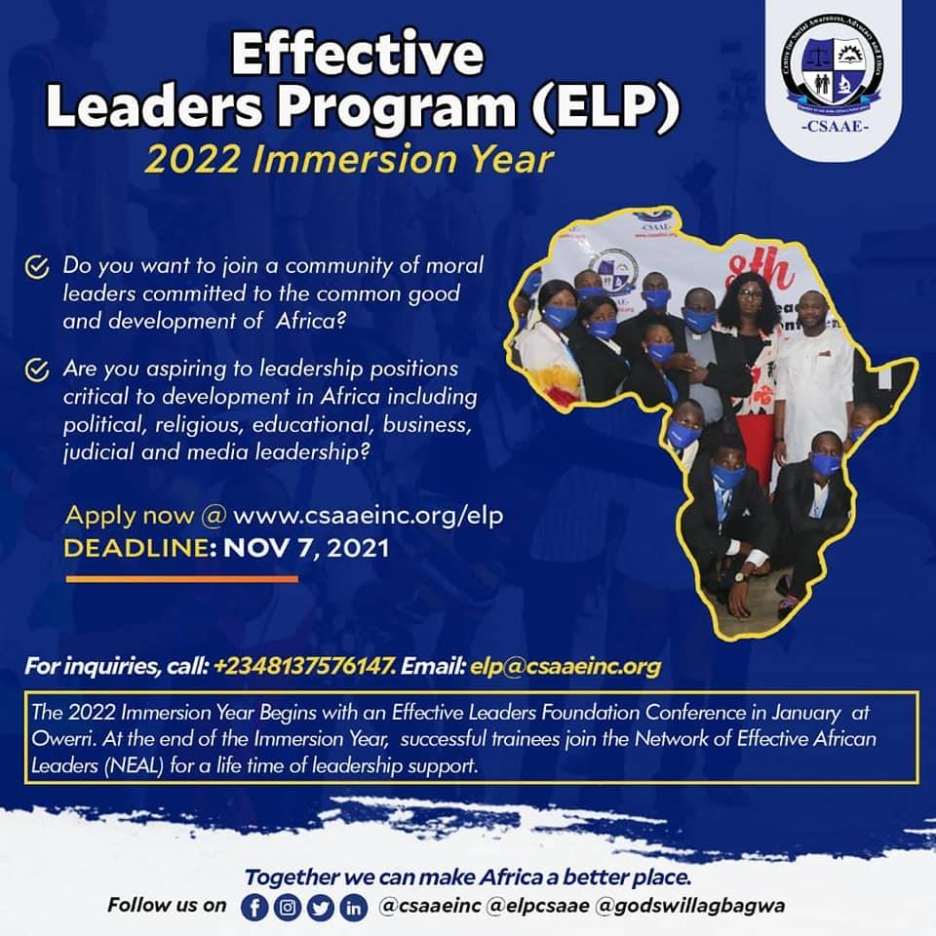
Effective Leaders Program 2022 Immersion Year 

CSAAE Hosts Effective Leadership Program 2022: Shaping the Future of African Leadership  In November 2022, Owerri once again became the epicenter of transformative leadership development as the Centre for Social Awareness, Advocacy, and Ethics (CSAAE) organized its annual Effective Leadership Program. The event welcomed 100 passionate and determined young participants, all eager to refine their leadership potential and embark on a journey toward creating meaningful change in their communities and beyond.  The program, known for its rigorous and impactful structure, provided an immersive experience designed to instill the essential principles of effective leadership. From thought-provoking discussions on ethical leadership to practical strategies for navigating complex societal challenges, participants were equipped with invaluable knowledge and skills.  What sets this program apart is its enduring commitment to the personal and professional growth of its attendees. 24 participants were selected for a 12 months rigorous leadership training, and they were further inducted into CSAAE’s lifelong mentorship network — a vibrant community of emerging African leaders connected by a shared vision of a better future. This network ensures that the journey doesn’t end when the conference closes; it’s only the beginning. Mentees continue to receive guidance, support, and opportunities as they pursue their diverse aspirations, whether in public service, entrepreneurship, academia, or civil society.  The 2022 Effective Leadership Program underscored CSAAE’s unwavering dedication to empowering the next generation of African leaders. By fostering a culture of ethical leadership, the organization is paving the way for a new era of leadership rooted in integrity, innovation, and compassion.  As the participants move forward with their newfound insights and a robust support system, they carry the torch of change — one that will undoubtedly illuminate a brighter, more just, and prosperous Africa. 

Effective Leaders Program 2022 Immersion Year  Read More »