
C-Ethics

C-Ethics Inspires Young Minds at Children’s Day Teen/Youth Summit

As part of its commitment to shaping ethical, value-driven youth, C-Ethics, a flagship initiative of CSAAE, proudly participated in the 2025 Children’s Day Teen/Youth Summit hosted by St. Stephen’s Anglican Church, Orji Imo State. Themed “Pharaoh’s Dream” (Genesis 41:1–49), the one-day summit—held on Tuesday, May 27th, 2025—gathered teenagers and young adults for a transformational experience centered on moral reawakening, academic focus, and personal development. The event featured a variety of sessions including exhortation, education seminars, tech talks, and health discussions. Representing C-Ethics was Mr. Solomon Chidi, the Ethics and Compliance Officer at CSAAE, who delivered a thought-provoking presentation titled “Owning Your Future: Education, Planning, and Purpose.” Addressing a vibrant audience of young people, Mr. Chidi encouraged them to become proactive architects of their own futures through careful planning, goal-setting, and sustained dedication to learning. He confronted the popular but misleading street slogan “School na scam”—a phrase that has gained traction among disillusioned youth. In a powerful counterstatement, Mr. Chidi declared: “School no be scam.” He emphasized that while education may not guarantee immediate wealth, it remains a timeless foundation for opportunities, character building, and nation-building. “Don’t let frustration or peer pressure push you into believing that education has no value,” he said. “The truth is, when rightly pursued and paired with purpose, education empowers you to dream, to lead, and to create lasting impact.” His message deeply resonated with the audience, sparking moments of reflection and lively engagement. Several participants shared personal aspirations and challenges, while others expressed a renewed desire to stay focused on their goals despite societal pressure. More than just a celebration, the event catalyzed values-driven youth transformation—a mission that aligns seamlessly with C-Ethics’ vision. About C-EthicsC-Ethics is an initiative under CSAAE committed to promoting ethical leadership, accountability, and value reorientation among youth. Through school outreaches, mentorship, training, and public advocacy, C-Ethics continues to raise a new generation of leaders who live with integrity and lead with purpose.

C-Ethics Inspires Young Minds at Children’s Day Teen/Youth Summit Read More »

Nigeria’s 10th Assembly for US Training April 27 – CSAAE 

The Centre for Social Awareness, Advocacy and Ethics (CSAAE), a frontline Civil Society Organization, has announced its readiness to undertake the training of legislators from Nigeria’s 10th Assembly in the United States.  This is contained in a statement by CSAAE’s Executive Director, Fr Godswill Agbagwa, made available to newsmen in Owerri, on Friday.  Agbagwa, a Catholic priest, said the training was borne out of a desire to equip Nigeria’s legislators with requisite 21st century knowledge and skills for more holistic, proactive law making.  He said that the three-day training tagged:” Cybersecurity , Data Protection And Best Practices In Financial Lawmaking “ will feature 11 members of Nigeria’s National Assembly led by the Deputy Senate President, Sen. Barau Jibrin.  According to him, this is in line with CSAAE’s Ethics Program Area and impact areas of good governance and the rule of law.   “ We are committed to ensuring that we contribute our quota to the Nigeria of our dreams through actionable initiatives capable of delivering quality results.   “ As an organization saddled with the responsibility of human rights advocacy, we consider the role of lawmakers as crucial to ensuring that human rights are protected and upheld, hence the training “, he said.  C-Advocate Newspapers promises to provide timely coverage of the training for our reading audience in the US, Nigeria and other parts of the world. 

Nigeria’s 10th Assembly for US Training April 27 – CSAAE  Read More »

Why You Should Train your Staff on Workplace Ethics and Emotional Intelligence 

In today’s fast-paced and increasingly complex work environments, technical expertise alone is no longer enough to build a thriving organization. Businesses that want to excel must also prioritize how their people work—not just what they do. That’s why training your staff on workplace ethics and emotional intelligence (EI) is not just a nice-to-have but a critical investment in long-term success.  1. Workplace Ethics: The Foundation of Trust and Integrity  Every successful company is built on trust. Whether it’s between co-workers, clients, or management, trust drives collaboration, loyalty, and performance. Ethical training helps employees understand the core values that define your organization, including honesty, fairness, respect, accountability, and professionalism.  Why it matters:  2. Emotional Intelligence: The Secret Sauce of Effective Teams  Emotional intelligence refers to the ability to recognize, understand, and manage your own emotions—and the emotions of others. In a world where teamwork, communication, and adaptability are key, EI is what separates good teams from great ones.  Why it matters:  3. Ethics + EI = Better Decision Making  When staff combine ethical reasoning with emotional intelligence, they make better decisions—ones that are not only smart but also fair, compassionate, and aligned with your values. This combination leads to a healthier, more productive workplace where people feel safe, respected, and driven to contribute their best.  4. It’s a Competitive Advantage  Training your staff in ethics and EI signals to the world that you are a forward-thinking organization that invests in people, not just profits. This can set you apart in your industry, improve customer satisfaction, and attract socially conscious partners and investors.  Final Thoughts  Workplace ethics and emotional intelligence are not soft skills—they are essential skills. When you train your staff in these areas, you’re not just preventing problems; you’re building a resilient, values-driven, and emotionally smart workforce ready to face the future.  If you want to grow a business that lasts, start by growing your people.  Ready to transform your team?  At CSAAE, we offer customized training programs in workplace ethics and emotional intelligence tailored to your team’s needs. Whether you’re a small business or a large corporation, we can help you build a more ethical, emotionally intelligent, and high-performing workplace.  Contact us today to schedule a free consultation or learn more about our training packages. 

Why You Should Train your Staff on Workplace Ethics and Emotional Intelligence  Read More »

Why You Should Have a Trained Ethics and Compliance Person on Your Team 

In today’s fast-paced and highly regulated business environment, organizations face increasing scrutiny over their ethical practices and compliance with laws and regulations. From corporate governance to workplace ethics and legal requirements, ensuring that an organization operates with integrity is more critical than ever. This is where a trained Ethics and Compliance professional becomes indispensable. Below are key reasons why having a dedicated expert in ethics and compliance is essential for any organization.  1. Mitigating Legal and Financial Risks  One of the most significant benefits of having a trained Ethics and Compliance person on your team is risk mitigation. Organizations operate under numerous laws and regulations, and failure to comply can lead to legal consequences, hefty fines, and reputational damage. A compliance expert ensures that policies and practices align with legal requirements, reducing the likelihood of legal trouble.  2. Fostering an Ethical Corporate Culture  An ethical workplace is a productive and sustainable one. Ethics and compliance professionals help shape company culture by promoting transparency, accountability, and fairness. They establish codes of conduct, train employees on ethical behavior, and provide mechanisms for reporting misconduct. This helps build a culture of trust and integrity within the organization.  3. Enhancing Reputation and Stakeholder Trust  In the digital age, reputation is everything. Companies that fail to uphold ethical standards often face backlash from customers, investors, and the public. An Ethics and Compliance officer ensures that the organization maintains a strong ethical stance, enhancing stakeholder confidence and brand reputation. Ethical businesses attract more investors and loyal customers, leading to long-term success.  4. Ensuring Compliance with Industry Regulations  Different industries have unique regulatory requirements. Whether it’s healthcare, finance, manufacturing, or technology, compliance is crucial to avoid penalties and maintain operational licenses. A trained Ethics and Compliance professional stays up-to-date with industry regulations, ensuring that the organization is always in compliance.  5. Protecting Employees and Encouraging Whistleblowing  Workplace ethics go beyond compliance; they also ensure a safe and fair environment for employees. An Ethics and Compliance professional implements anti-discrimination policies, addresses harassment issues, and provides a confidential system for reporting unethical behavior. This not only protects employees but also prevents potential lawsuits and internal conflicts.  6. Improving Decision-Making and Corporate Governance  Ethics and compliance professionals play a crucial role in corporate governance. They provide guidance to leadership on ethical dilemmas, ensuring that business decisions align with legal and moral standards. Their presence helps executives make informed decisions that benefit both the company and its stakeholders.  7. Enhancing Business Sustainability  Sustainability is a growing concern for organizations worldwide. Ethical business practices ensure long-term success by avoiding shortcuts that could lead to legal and reputational crises. Ethics and Compliance officers promote corporate social responsibility (CSR) initiatives, sustainability practices, and fair labor policies, positioning the company as a responsible corporate citizen.  Conclusion  Having a trained Ethics and Compliance professional on your team is no longer a luxury but a necessity. Their expertise safeguards the organization against legal risks, strengthens its reputation, and fosters an ethical work environment. In a world where ethics and transparency are more important than ever, investing in an Ethics and Compliance professional is a strategic move that ensures sustainable growth and long-term success.  If your organization has not yet integrated an Ethics and Compliance expert into its team, now is the time to do so. The benefits far outweigh the costs, and the long-term impact on your business’s integrity and stability is invaluable.  Contact us today to get trained. 

Why You Should Have a Trained Ethics and Compliance Person on Your Team  Read More »

Ethical Imperatives of Pension Compliance in Nigeria: A Call for Corporate Responsibility 

Pension compliance is not just a legal obligation but a fundamental ethical responsibility of employers toward their workforce. In Nigeria, and particularly in Imo State, the widespread non-compliance with the Pension Reform Act (PRA) 2014 has left many employees vulnerable, without financial security upon retirement. This systemic failure not only contravenes the law but also raises significant ethical concerns about corporate responsibility, employee welfare, and economic stability.  The Legal and Ethical Framework for Pension Compliance  The Pension Reform Act of 2014 mandates that all employers with three or more employees must enroll their staff in the Contributory Pension Scheme (CPS). Under this scheme, both employer and employee contribute a minimum percentage of the employee’s monthly salary to a pension fund. The objective is to ensure that workers have financial security in their post-employment years.  Beyond legal mandates, ethical considerations demand that employers uphold their duty of care by ensuring employees’ future well-being. Fair labor practices include not only paying salaries on time but also guaranteeing that employees can retire with dignity. Non-compliance with pension obligations amounts to corporate neglect and exploitation, undermining the principles of fairness, integrity, and justice in the workplace.  The Reality of Non-Compliance in Nigeria and Imo State  Despite clear legal provisions, many private-sector employers fail to implement the contributory pension scheme. In Imo State, as in many parts of Nigeria, pension compliance is alarmingly low. Several employers either do not remit pension contributions or fail to register their employees in the scheme altogether.  Ethical Responsibilities of Employers  Employers must recognize that pension compliance is an ethical obligation that transcends mere legal requirements. Ethical business practices should prioritize the long-term welfare of employees, fostering a culture of trust, accountability, and sustainability. Companies that fail to comply with pension regulations effectively exploit their workforce, depriving them of the security they deserve after years of service.  Corporate social responsibility (CSR) should extend beyond philanthropy to include compliance with labor laws and ethical employment practices. Ethical employers should:  The Role of Government and Regulatory Bodies  While the onus of compliance primarily rests on employers, the government and regulatory bodies such as the National Pension Commission (PenCom) must strengthen enforcement mechanisms. This includes:  A Call to Action  Ethical business practices demand that employers treat their employees with dignity, ensuring that they have financial security in retirement. In Nigeria, and specifically in Imo State, pension non-compliance is a glaring ethical failure that must be addressed. Employers, regulators, and employees must collectively advocate for full pension compliance to build a fairer, more sustainable labor system.  Companies that prioritize ethical responsibility by adhering to pension regulations will not only foster a loyal and motivated workforce but also contribute to economic stability and social justice. Now is the time for organizations to step up and fulfill their moral and legal duties toward their employees.  Let us build a future where every Nigerian worker can retire with dignity and security. 

Ethical Imperatives of Pension Compliance in Nigeria: A Call for Corporate Responsibility  Read More »

Combating Sexual Harassment in Nigerian Workplaces: A Call for Ethical Reforms

Sexual harassment remains a pervasive issue in many Nigerian workplaces, affecting both men and women — though women are disproportionately impacted. This toxic behavior not only violates the dignity of individuals but also undermines productivity, morale, and the overall organizational culture. As Nigeria continues to push for gender equity and safer working environments, organizations must take deliberate steps to prevent, address, and eliminate sexual harassment. In Nigeria, the Violence Against Persons (Prohibition) Act (VAPP) and other workplace regulations acknowledge sexual harassment as a punishable offense. However, laws alone are insufficient without proper implementation and proactive organizational measures. Why Organizations Must Take Action The cost of ignoring sexual harassment is high — and not just financially. It breeds a toxic work culture, increases employee turnover, and damages an organization’s public image. Employees who feel unsafe or unprotected are less productive, less engaged, and more likely to leave, resulting in brain drain and a loss of institutional knowledge. By creating a workplace culture rooted in respect and ethical behavior, organizations can foster a more productive, inclusive, and motivated workforce. Compliance training, clear policies, and effective reporting mechanisms are crucial to achieving this. CSAAE’s Role in Shaping Ethical Workplaces Recognizing the urgent need to tackle this issue head-on, CSAAE has developed a comprehensive Sexual Harassment Policy that organizations can adopt and domesticate to suit their unique operational contexts. This policy is designed to help organizations build safer, more ethical workplaces by setting clear guidelines on what constitutes harassment, how to report incidents, and the disciplinary measures to follow. Additionally, CSAAE’s Ethics and Compliance Department offers comprehensive Ethics, Risk, and Compliance trainings — empowering organizations to build strong ethical cultures, mitigate risks, and stay compliant with national and international standards. The fight against sexual harassment requires more than policies — it demands a sustained cultural shift. With the right frameworks and training, Nigerian workplaces can become safer, more inclusive, and more productive. Now is the time to take action — and CSAAE stands ready to support this transformation. Contact us for more information on adopting CSAAE’s Sexual Harassment Policy or enrolling your team in our Ethics and Compliance training. Let’s build safer, more ethical workplaces together!

Combating Sexual Harassment in Nigerian Workplaces: A Call for Ethical Reforms Read More »

Ethics First: CSAAE Sparks Change in Healthcare Delivery

On January 22, 2025, CSAAE, in partnership with the College of Nursing Science, Mater Misericordiae Hospital Afikpo, organized a transformative workshop titled “Healthcare Ethics: Key to Quality and Inclusive Healthcare Service Delivery in Nigeria. This event brought together future healthcare professionals and industry experts to address one of the most critical aspects of modern healthcare: ethics Ethics is the backbone of quality healthcare. It governs the decisions, practices, and interactions that define patient-centered care, inclusivity, and trust within the healthcare system. Recognizing this, CSAAE organized the workshop to deepen participants’ understanding of ethical principles and equip them with practical tools for delivering quality and inclusive healthcare services in Nigeria A strong Turnout The event saw an overwhelming response, with 785 students and 15 staff members in attendance. Participants gathered in anticipation of what proved to be a thought-provoking and transformative experience, reflecting the growing awareness of ethics as the foundation of professional healthcare practice Why Healthcare Ethics Matters In Nigeria, the healthcare system faces unique challenges, from inadequate resources to accessibility issues. Ethical practices serve as a unifying framework to address these challenges while maintaining the dignity and rights of patients. This workshop highlighted the pressing need for ethical principles to guide every healthcare decision, ensuring inclusivity and quality remain non-negotiable Looking Ahead CSAAE’s commitment to fostering ethical leadership extends beyond this workshop. The organization continues to champion initiatives that promote professional excellence and social advancement across various sectors. As Nigeria’s healthcare system evolves, CSAAE stands firm in its resolve to nurture a culture of ethical awareness. The lessons from this workshop will undoubtedly ripple through the participants’ future practices, creating a healthier, more inclusive society. This workshop is just one of many steps CSAAE is taking to ensure that ethics remains central to Nigeria’s healthcare narrative. By partnering with the College of Nursing Science, Mater Misericordiae Hospital, CSAAE once again proved that collaboration between advocacy organizations and educational institutions is key to driving systemic change. This event leaves a lasting legacy, inspiring future healthcare professionals to deliver care grounded in ethics and compassion.

Ethics First: CSAAE Sparks Change in Healthcare Delivery Read More »

CSAAE ETHICS QUIZ 2024: Celebrating Ethical Excellence in Nigerian Universities

On December 14, 2024, the Centre for Social Awareness, Advocacy, and Ethics (CSAAE) concluded its highly competitive Ethics Quiz for Nigerian undergraduates, marking a milestone during its 10th anniversary celebrations. Sponsored by the Bet9ja Foundation, the quiz brought together over 200 students from 80 universities across Nigeria to test their ethical reasoning skills. Competition Highlights The quiz, which focused on current ethical challenges and practical decision-making, aimed to assess how well students could apply moral principles to real-life situations. After intense rounds of competition, three teams emerged as the winners, receiving cash prizes and award plaques: First Place: University of Jos (UNIJOS), with 500,000 Naira, represented by Chiamaka Goodness Nwachukwu, Paul Nichodemus Shantong, and Loveson Uyo-Ojo Anselm Ahman. Second Place: Federal University of Technology Owerri (FUTO), awarded 400,000 Naira. Their team included Johnson Chukwuemeka Anoruo, Cosmas Ikechukwu Chukwu, and Okolorie Chibuikem Donald. Third Place: University of Abuja (UNIABUJA), with 300,000 Naira, represented by Shalom Onomen Oifoh, Martha Ifedolapo Bankole, and Manna Ezechukwu Nnamani. During the award presentation, CSAAE’s founder Rev. Fr. Dr. Godswill Agbagwa encouraged the winners to serve as ethical role models and to use their prizes judiciously for further growth and learning. “This competition is not just about winning prizes,” the founder stated. “It is about cultivating ethical leaders who can make sound decisions and positively impact society. We want to inspire young people to lead with integrity and take responsibility for creating a more ethical world.” CSAAE’s Vision for Ethical Leadership The Ethics Quiz is part of CSAAE’s broader mission to foster ethical consciousness among Nigeria’s youth. Over the past three years, more than 5,000 young people have participated in CSAAE’s ethics contests, demonstrating the growing interest in ethical issues and leadership development across the country. As the organization celebrates a decade of work, CSAAE remains focused on its vision of nurturing a generation of leaders who prioritize integrity and ethical responsibility. With continued support from partners like the Bet9ja Foundation, CSAAE is poised to expand its efforts in promoting a culture of ethics and responsibility among young Nigerians.

CSAAE ETHICS QUIZ 2024: Celebrating Ethical Excellence in Nigerian Universities Read More »

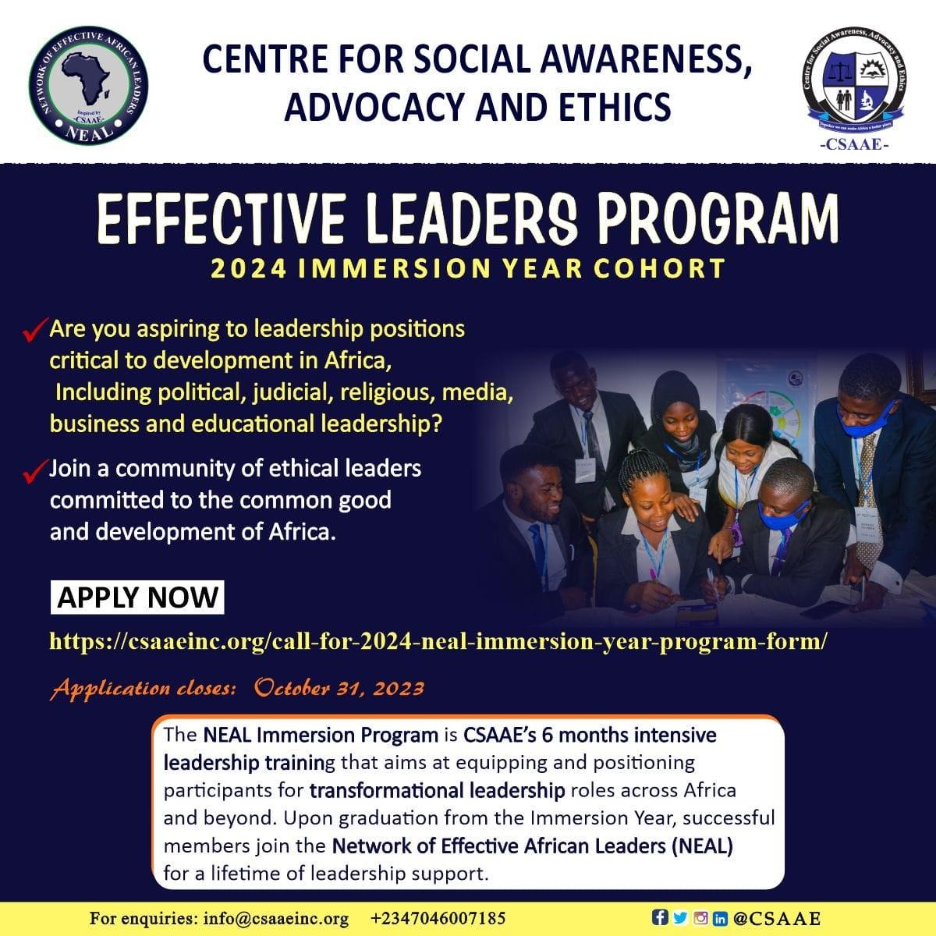
Effective Leaders Program 2024 Immersion Year Cohort 

Emerging African Leaders Foundation Conference 20224 Shaping the Future of Leadership in Africa  In 2024, the Centre for Social Awareness, Advocacy, and Ethics (CSAAE) organized the Effective Leaders Program bringing together 100 dynamic young individuals from across the country for virtual leadership training. 24 participants were selected to proceed to 6 months leadership training. This marked a pivotal moment in nurturing the next generation of African leaders committed to driving ethical, sustainable change in their communities and beyond.  This served as an intensive platform for fostering leadership skills, ethical decision-making, and personal development. Throughout the 6 months training, participants engaged with seasoned leaders, explored real-world challenges, and delved into practical strategies for creating lasting impact.  However, the true hallmark of this conference goes beyond the powerful sessions and engaging discussions. Each participant was inducted into CSAAE’s lifelong mentorship network — a transformative program designed to guide and support emerging leaders as they pursue diverse personal and professional goals. This network connects young change makers with experienced mentors, providing invaluable insight, encouragement, and resources to help them navigate their leadership journey.  CSAAE remains steadfast in its mission to empower young Africans to become the ethical, effective leaders the continent needs. The 2024 program added another cohort of future trailblazers to the ever-growing network of emerging leaders — individuals who are poised to make a lasting difference in governance, entrepreneurship, and social development.  As we continue to witness the achievements of past and present participants, one thing is clear: the seeds of leadership planted during this program will continue to bear fruit for years to come, shaping a brighter and more just future for Africa. 

Effective Leaders Program 2024 Immersion Year Cohort  Read More »

NATIONAL UNDERGRADUATE ETHICS QUIZ!

Dear Nigerian Sudents, Don’t miss this last chance to join the NATIONAL UNDERGRADUATE ETHICS QUIZ! Registrations have been extended until Sunday, 1st December 2024. Don’t miss this opportunity to showcase your knowledge, represent your school, and win amazing prizes! Encourage your friends to join the challenge, too! Register now and be part of a transformative experience. Click here to register: https://cethics.csaaeinc.org/ethics-contests-and-awards

NATIONAL UNDERGRADUATE ETHICS QUIZ! Read More »